The planned Homeland Security raid on Coldiron
The PeripheralThe planned Homeland Security raid on Coldiron turns a looming display of federal force into a contest over political leverage, public narrative, and who receives credit for ending Corbell Pickett’s drug empire. Homes prepares a substantial deployment against the people at Coldiron, while Flynne Fisher’s side recognizes that resistance could be framed as criminal defiance; the operation is halted only after a shift in influence allows Homeland Security’s orders to be withdrawn.
Causes and Political Context
The immediate warning reaches Flynne through a discussion of media attention. Her interlocutor suspects that people have been drawn away because their presence could amplify coverage of another event. Flynne’s public-relations operation has already kept her largely out of the news, but their departure has nevertheless produced a small spike in attention. If something else is about to happen in town, removing a potential media draw would help ensure that the additional attention does not fall on it.
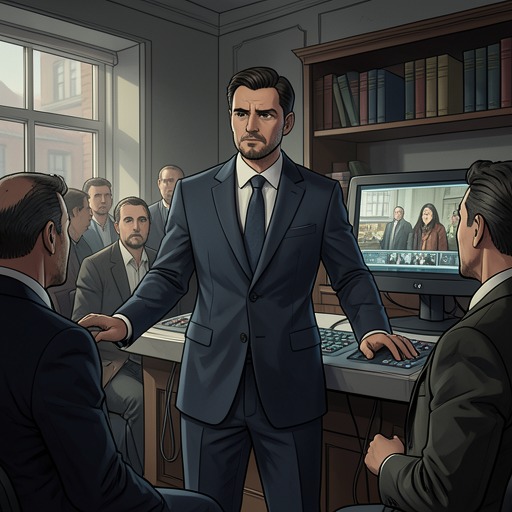
That concern becomes concrete in the report of a large Homes mobilization: two major convoys of white trucks are headed toward the area, accompanied by a substantial deployment of vehicles and personnel. At what remains of Pickett’s property, Ben Carter’s cousin is with a sizeable Homes detachment. The account reaching Ben says the agency is coming that day to clear out what it describes as the armed remnants of Corbell Pickett’s multicounty drug empire. The stated framing credits Homes with ending that empire, rather than Burton Fisher, Burton’s friend, and Conner Penske, whose actions had helped bring about its collapse.
The warning therefore concerns more than an enforcement operation. It exposes a struggle over attribution: an agency can present itself as the force that restored order while obscuring the actions of local people. The agency’s movement against Coldiron also takes place in a county where political power has already been shaped by competing interests and purchases of influence. Macon says that Coldiron has lawyers because it may face state police, Homes, another federal agency, or even the Marines, forces against which Burton’s group could not simply fight its way through. His warning places the threatened raid within a wider contest over who can command institutional power.
The Threat and the Expected Outcome
Flynne asks what will happen when Homes arrives. The answer is that the group will resist arrest, and that, whatever its actual conduct, the episode will be defined as having resisted arrest. The distinction is politically consequential: an armed response can become the justification for a forceful operation, while the label attached to the response may be settled before the confrontation begins.
The defenders’ improvised position offers little protection. The stacks of shingles cannot stop precision weapons; the building’s roof would offer no meaningful shelter from the kind of attack drones Homes possesses, and a bunker would not solve the problem. Burton’s men are also described as constitutionally disinclined to surrender peacefully despite the odds. The prospect is thus not a balanced standoff but a threatened assault in which the state’s weapons and the likely public account of events reinforce one another.
The timing is explained through an image of political hands crowding around a bat’s handle. Griff’s assessment is that both sides have reached the top of their available leverage: Homes has been brought into the other side’s pocket, and Coldiron has nothing left to buy that could bring the agency into its own. The language makes the raid’s apparent inevitability a consequence of accumulated political transactions, not simply a response to immediate danger.
Intervention and Cancellation
The threatened operation becomes urgent when Flynne demands action against Homes and its drones. She still has her candy-cane gun, but her question is directed beyond the immediate confrontation: she wants someone to act in the Stub to stop the agency from killing them. Ainsley Lowbeer then explains that Sir Henry Fishbourne’s death has deprived Coldiron’s competitor of an advantage that Lev Zubov and Lowbeer had been providing to Flynne’s side. Lowbeer says she acted as soon as Sir Henry arrived, on the assumption that he would prove guilty; his death consequently shifted influence.
That shift produces a direct institutional result. Lowbeer reports that Homeland Security has withdrawn and that its orders have been rescinded. Flynne asks what they had to buy to bring about the change. Lowbeer’s cautious answer is that it apparently required a sufficient share in the parent corporation of Hefty Mart, though she has not yet learned the details. The raid is therefore averted not by the local defenders’ capacity to defeat Homes in combat, but through a change in the balance of influence and a corporate stake with political consequences.
Consequences and Significance
The cancellation reverses the immediate direction of the crisis without erasing the political structure that produced it. Before Lowbeer’s intervention, Coldiron faces convoys, personnel, attack drones, and a likely public narrative that would cast the local group as armed remnants resisting lawful arrest. After the intervention, Homes’ orders are rescinded. The decisive change is not a victory at the threatened site but the withdrawal of authorization from above.
The episode also establishes how control of public attention and control of state force intersect. The possibility that people have been moved to prevent them from becoming a media attraction suggests that the coming operation is being managed as a story as well as a deployment. The account of Homes clearing Pickett’s remaining organization would make the agency appear responsible for ending the drug empire, while minimizing the contribution of Burton, Conner, and their allies. What is at stake is consequently both physical survival and the ability to define what has happened.
In the aftermath, Coldiron becomes a durable base for a larger enterprise rather than merely the target of a foiled operation. Flynne later reflects that the organization is only beginning to exploit a technological surge from the Jackpot, and that its program deliberately tries to pace the introduction of new capabilities so that change does not become unmanageable. The future operation of Coldiron is tied to secrecy, including specially controlled printing work by Macon and Edward, because industrial espionage is a central concern. That later development gives the threatened raid a broader significance: Coldiron is not only a local political actor but an emerging center of valuable technology, making influence over it a continuing matter of security and economic power.
Narrative Role
The episode stages security as both a material danger and a claim to authority. Homes’ capacity to deploy convoys and attack drones makes its threat credible, while its proposed account of the drug empire’s defeat shows how an agency can claim the legitimacy of restoring order and displace inconvenient local actors. Coldiron’s answer is not a stronger defense but the use of political and corporate leverage through Lowbeer’s network. The rescinded orders mark a narrow reprieve, while leaving intact the uncomfortable condition that survival depends on who can shape institutional influence as well as who holds the weapons.